Synthetic observations
Numerically generated SIRD values provide controlled data points for the four state trajectories.
Project case study · Scientific machine learning
A controlled experiment in which synthetic observations and the governing epidemic equations train the same neural network.
A standard data fit can reproduce observations while behaving poorly between them or violating known dynamics. This project adds the differential equations to the training objective, so the learned curves must answer to both data and model structure.
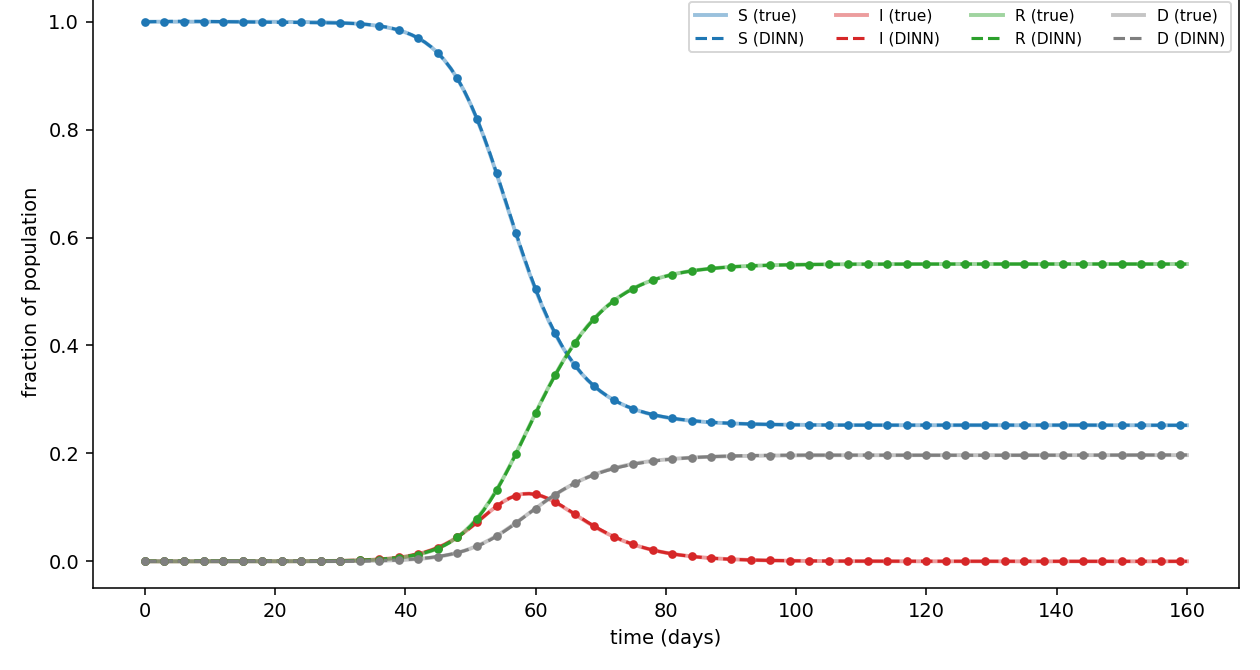
Phase 1 result
The horizontal axis is time in days. The vertical axis is the fraction of the modeled population in each state. S is susceptible, I is infected, R is recovered, and D is deceased.
Method
Numerically generated SIRD values provide controlled data points for the four state trajectories.
Penalizes differences between the neural-network output and the synthetic observations.
Anchors the learned trajectory at the known state of the system at the start of the experiment.
Uses automatic differentiation to measure how closely the network output satisfies the SIRD equations through time.
Treats selected model parameters as quantities to be recovered jointly with the state trajectories.
Interpretation
The current figure shows that the network can reproduce the synthetic SIRD trajectory under the implemented loss. On the same synthetic experiment, the learned transmission, recovery, and mortality parameters were 0.5000, 0.2000, and 0.0715, compared with generating values of 0.5000, 0.2000, and 0.0714. Each relative error was below 0.1%.
Those results belong to a controlled synthetic setting. This version does not make claims about real-outbreak estimation, forecasting, deployment, or uncertainty.
Planned extensions
These directions are part of the project plan, not current results.
Extend the controlled framework to connected regions so movement parameters and coupled dynamics can be studied explicitly.
Bring the scientific-machine-learning experiment closer to the patch-based SIS questions at the center of my doctoral research.